📌 Key Takeaways
- AI already runs quietly in your email, maps, health apps and entertainment.
- At work it removes busywork so humans focus on judgment.
- Biggest trade-offs: privacy, over-reliance and confident errors.
- Stay the one in charge of the tools.
Artificial intelligence stopped being a futuristic buzzword years ago. In 2026 it is woven quietly into the ordinary moments of daily life — the route you drive, the email you skim, the show you watch, the diagnosis your doctor confirms. Most of it happens invisibly. This article looks at how AI is genuinely reshaping everyday living, the benefits it brings, and the trade-offs worth paying attention to.
Your Morning Already Runs on AI
Before you finish your coffee, AI has already made dozens of decisions for you. Your phone filtered spam out of your inbox, prioritized the notifications it thought you cared about, and suggested the fastest route to work by reading live traffic. Your smart speaker understood a half-mumbled request. None of this feels like “using AI” anymore — it just feels like the phone working.
Work: From Busywork to Judgment
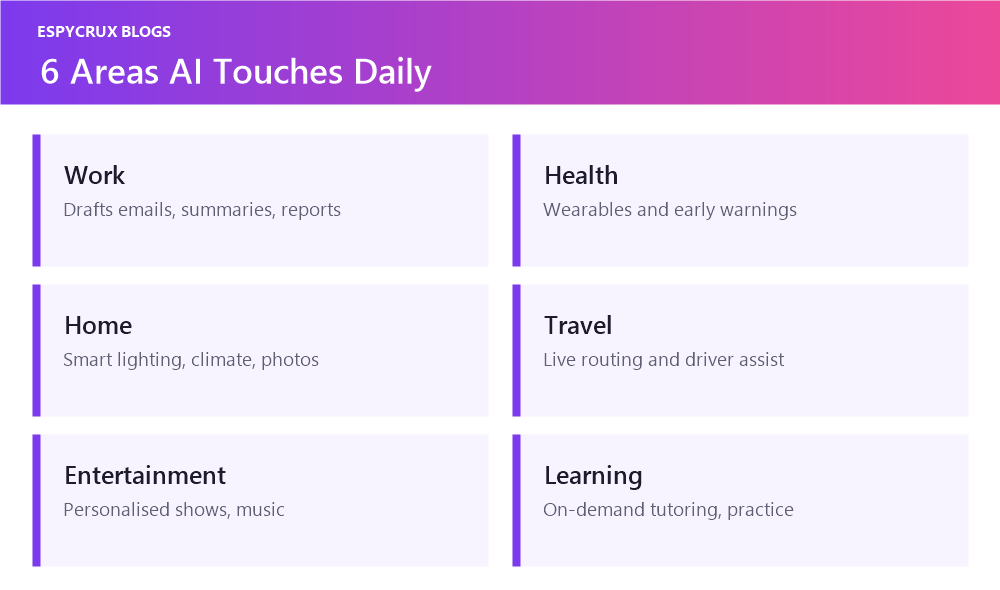
The biggest shift in 2026 is at work. AI assistants now draft emails, summarize long meetings, clean spreadsheets, and write first drafts of reports in seconds. The result is not mass unemployment but a change in what humans spend time on: less mechanical busywork, more judgment, strategy, and relationships.
- Writers use AI to beat the blank page, then edit for voice and accuracy.
- Developers ship faster with AI pair-programmers handling boilerplate.
- Analysts ask questions in plain English instead of writing complex queries.
The professionals thriving are the ones who treat AI as a capable junior teammate — delegating the routine, checking the output, owning the final call.
Health: Earlier Answers, Better Access
Healthcare is where AI’s impact feels most human. AI models now help radiologists spot patterns in scans, flag risky drug interactions, and give people in remote areas a first line of guidance through symptom-checking tools. Wearables track heart rhythm and sleep, nudging users toward healthier habits and catching warning signs earlier than an annual check-up ever could.
Crucially, these tools support doctors rather than replace them — the AI surfaces possibilities, and a trained professional makes the diagnosis.
Home and Entertainment
Your streaming queue, music playlists, and shopping suggestions are all curated by recommendation engines that learn your taste. Smart homes adjust lighting and temperature to your routines. AI photo tools turn a quick phone snapshot into a polished image. Entertainment has become deeply personalized — sometimes to the point of an echo chamber, which is worth being mindful of.
Getting Around
Navigation apps reroute you around accidents in real time, ride-hailing apps predict demand, and driver-assist features handle lane-keeping and emergency braking. Fully driverless taxis operate in a growing list of cities. Everyday travel is safer and more efficient than it was even a few years ago.
The Trade-Offs Worth Watching
Convenience has a cost, and honesty about it matters:
- Privacy: personalized AI runs on your data. Know what you are sharing.
- Over-reliance: outsourcing every small decision can dull our own skills.
- Bias and errors: AI is confident even when wrong, so human review still matters.
- The filter bubble: recommendation engines can narrow what you see.
The goal is not to reject these tools but to stay the one in charge of them.
The Bottom Line
AI in 2026 is less a robot revolution and more an invisible layer of help running underneath daily life. Used well, it gives us back time, catches things we would miss, and lowers the barrier to skills that used to take years. The people who benefit most are not the ones who use AI the most, but the ones who stay curious, keep their judgment sharp, and let the technology handle the routine so they can focus on what actually matters.
Frequently Asked Questions
It is changing tasks more than eliminating jobs — routine work shrinks while judgment and people skills grow in value.
Personalisation runs on your data. Review permissions and avoid sharing sensitive details you would not want stored.
Not blindly — AI can be confidently wrong, so verify anything important.