📌 Key Takeaways
- The best language depends on your goal, not hype.
- Python for AI and data; JavaScript plus TypeScript for the web.
- Swift, Kotlin or Dart for mobile; Rust or Go for performance.
- Master one deeply — fundamentals transfer everywhere.
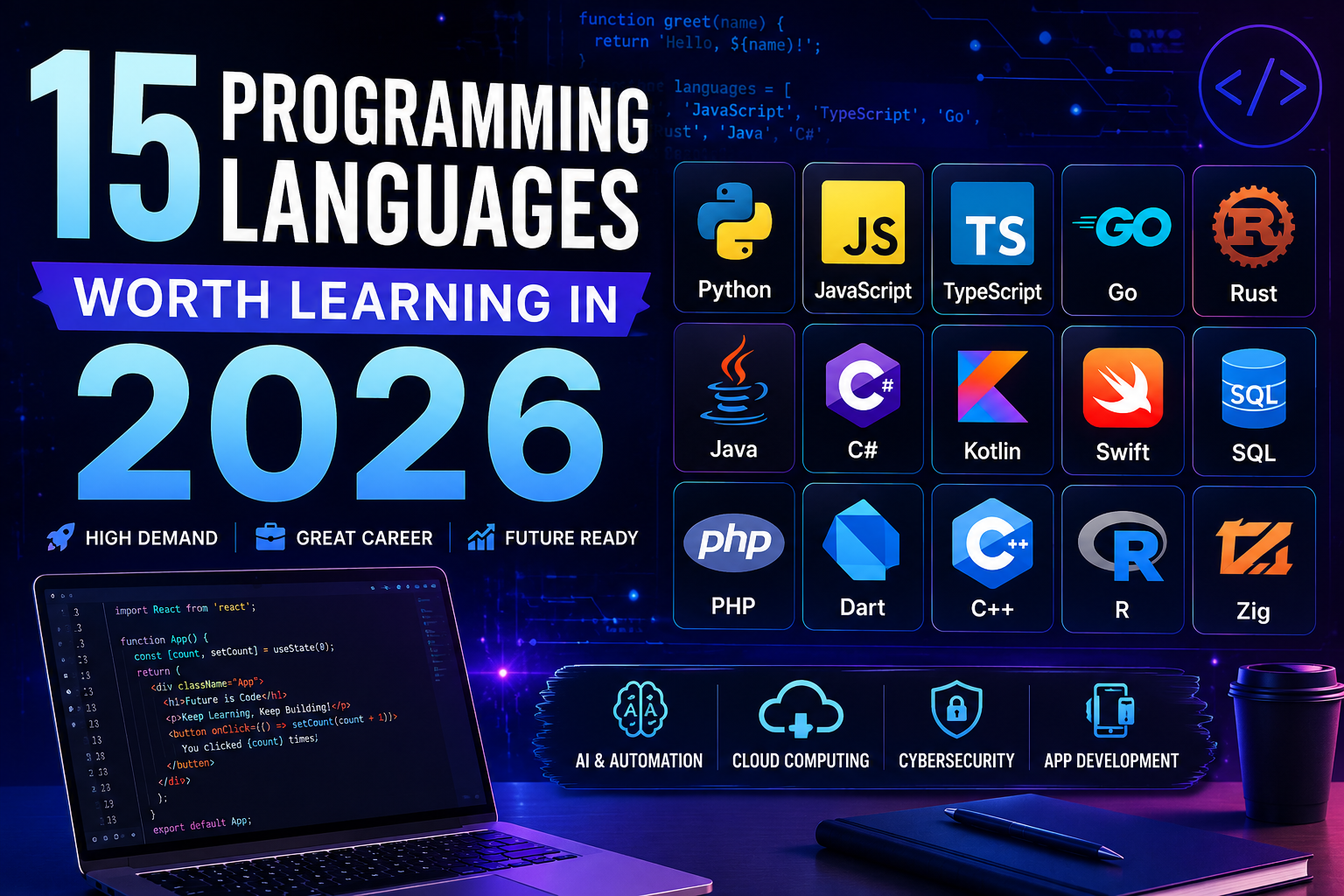
Choosing which programming language to learn in 2026 can feel paralyzing — there are dozens, everyone online swears by a different one, and the “wrong” choice feels expensive. The truth is simpler: the best language depends on your goal. This guide ranks 15 languages worth learning, explains what each is actually good for, and helps you pick without the guesswork.
Start Here: The Safe Bets for Beginners
1. Python
Still the best first language for most people. Clean, readable syntax and a massive ecosystem make it the top choice for AI, data science, automation, and backend work. If you learn one language in 2026, make it Python.
2. JavaScript
The language of the web, and unavoidable if you want to build for browsers. With Node.js it runs on the server too, making it a genuine full-stack option. High demand, huge community.
3. TypeScript
JavaScript with a safety net. TypeScript adds static types that catch bugs before they run, and it has become the default for serious web projects. Learn JavaScript first, then adopt TypeScript quickly.
For High-Performance and Systems Work
4. Rust
Loved for its speed and memory safety without a garbage collector. Rust is increasingly used for systems programming, game engines, and performance-critical web backends. A steeper learning curve, but a strong career bet.
5. Go
Designed for simplicity and concurrency. Go powers a huge amount of cloud infrastructure and backend services. It is fast, easy to deploy, and quick to learn — a favorite for scalable systems.
6. C++
Still the backbone of game development, high-frequency trading, and performance-sensitive software. Demanding, but unmatched when you need raw control and speed.
7. C
The foundation everything else is built on. Learning C teaches you how computers actually work — memory, pointers, and all. Essential for embedded systems and low-level programming.
For Mobile and App Development
8. Swift
Apple’s language for iOS, macOS, and beyond. If you want to build for the Apple ecosystem, Swift is modern, safe, and the clear choice.
9. Kotlin
The preferred language for Android development and a cleaner alternative to Java. Concise, safe, and fully interoperable with existing Java code.
10. Dart
The language behind Flutter, which lets you build iOS and Android apps from a single codebase. If cross-platform mobile is your goal, Dart is worth it.
For Enterprise, Data, and the Web
11. Java
Decades old and still everywhere — enterprise systems, Android, and large-scale backends. Stable, in constant demand, and a reliable career language.
12. C#
Microsoft’s versatile language for enterprise apps, Windows software, and game development with Unity. Powerful and well-supported.
13. SQL
Not a general-purpose language, but non-negotiable. Almost every application touches a database, and knowing SQL to query and shape data is a universal skill.
14. R
A specialist favorite for statistics, data analysis, and research. If your path is heavy on data and visualization, R complements Python well.
15. PHP
Powers a huge share of the web, including WordPress. Modern PHP is far better than its reputation, and demand for maintenance and development remains steady.
How to Actually Choose
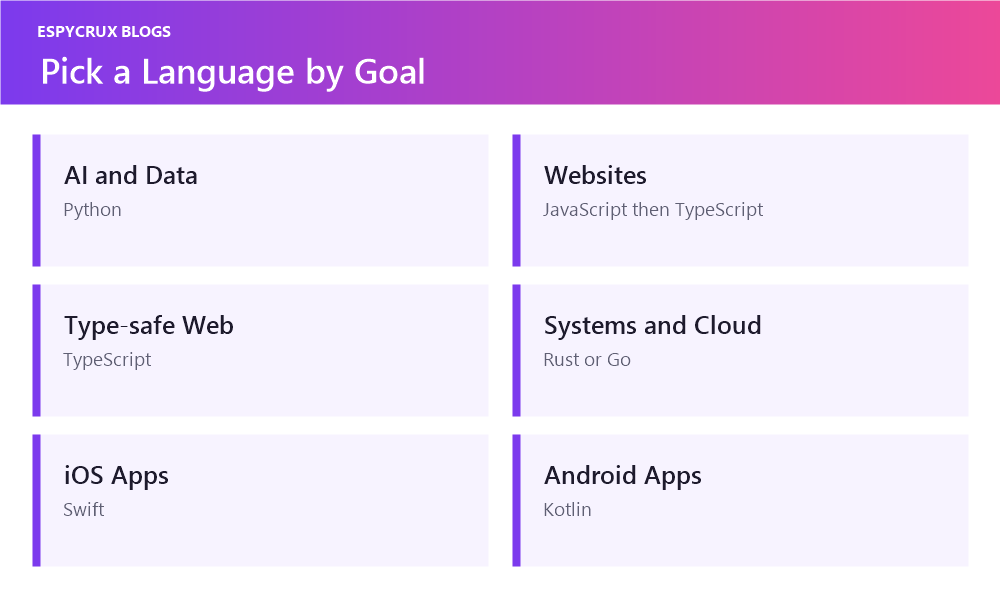
- Want AI, data, or automation? Python.
- Want to build websites? JavaScript, then TypeScript.
- Want mobile apps? Swift (iOS), Kotlin (Android), or Dart (both).
- Want high-performance systems? Rust or Go.
- Want stable enterprise work? Java or C#.
Final Thoughts
Do not chase every language — pick one that matches your goal and go deep. Fundamentals like logic, problem-solving, and clean code transfer everywhere, so your second language is always easier than your first. Start with Python or JavaScript in 2026, build real projects, and let your career point you to the next one.
Frequently Asked Questions
Python — clean syntax and huge demand across AI, data and automation.
One language plus real projects can land a job. Depth beats dabbling.
Pay tracks scarce, in-demand skills such as AI and systems more than any single language.



nice